A 210×210mm square publication. Pinch to zoom, or download the PDF.
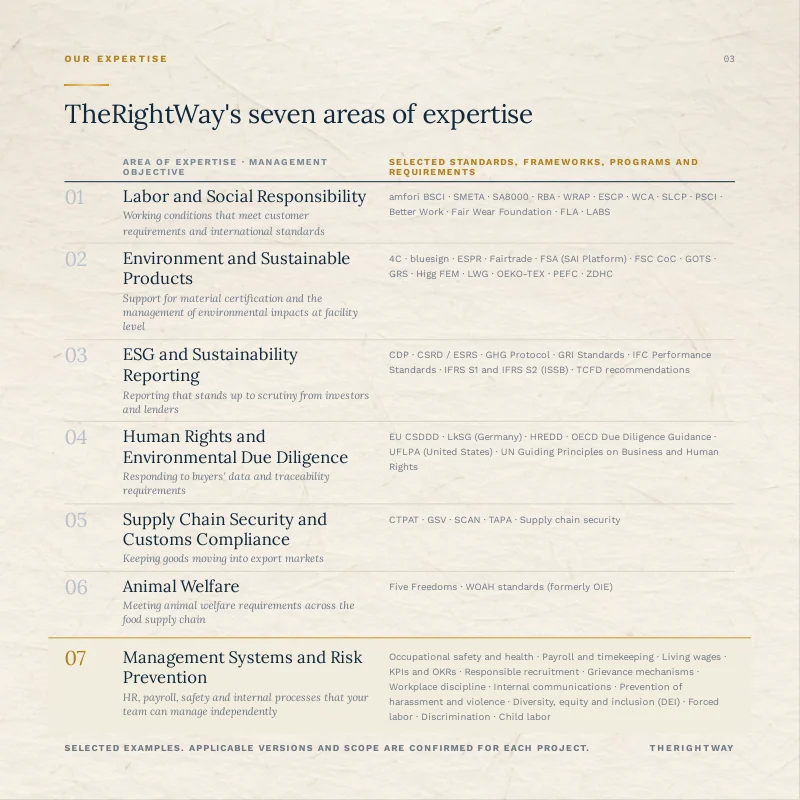
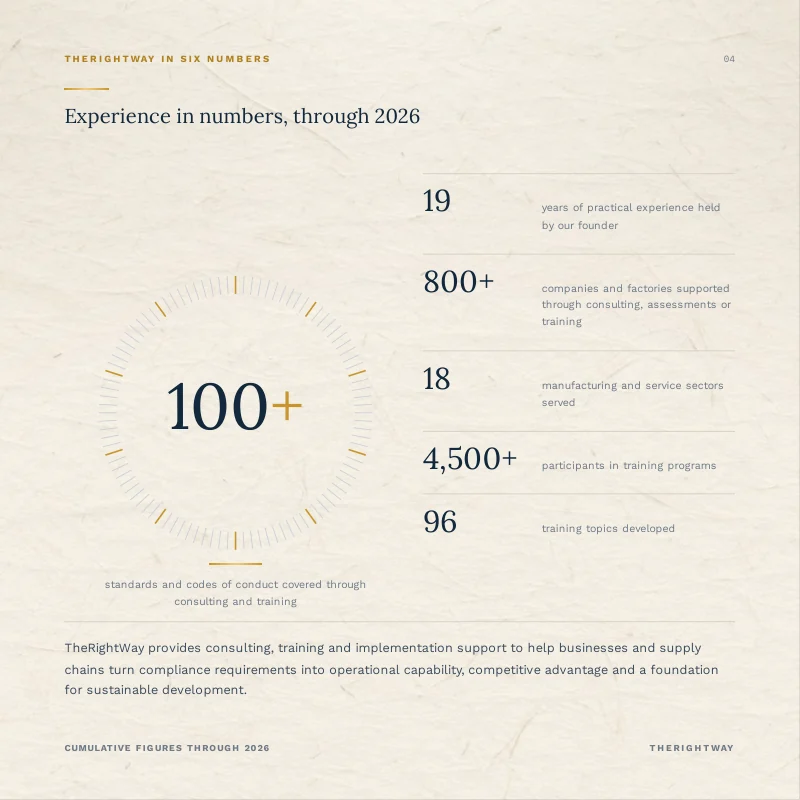
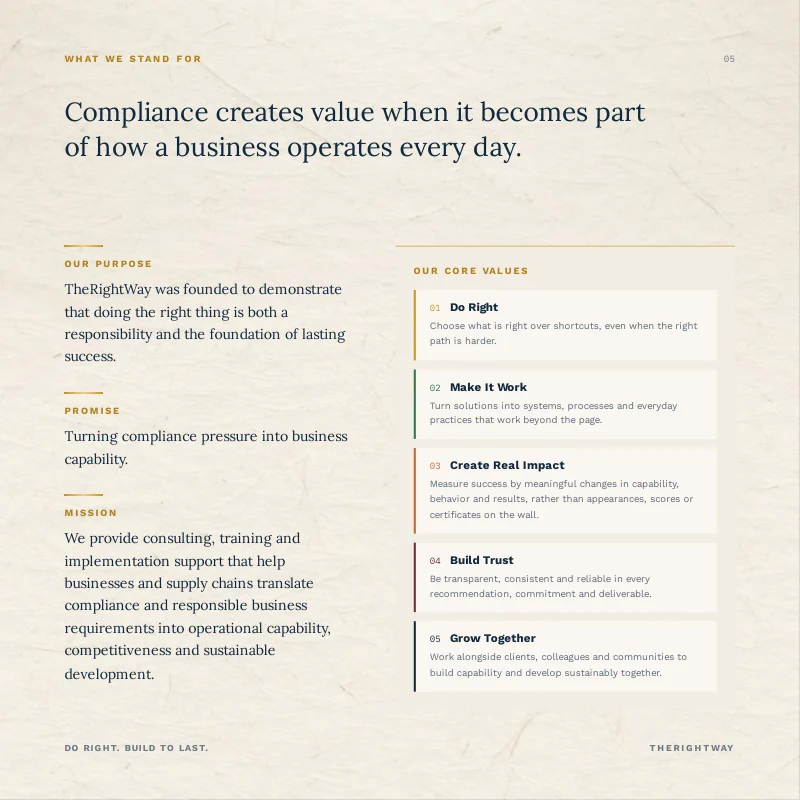
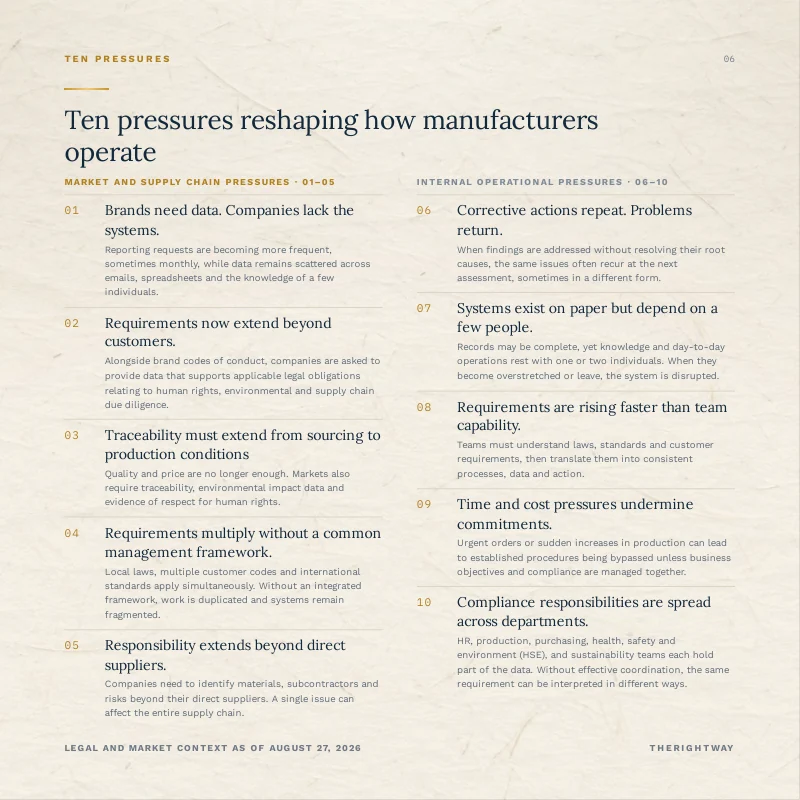
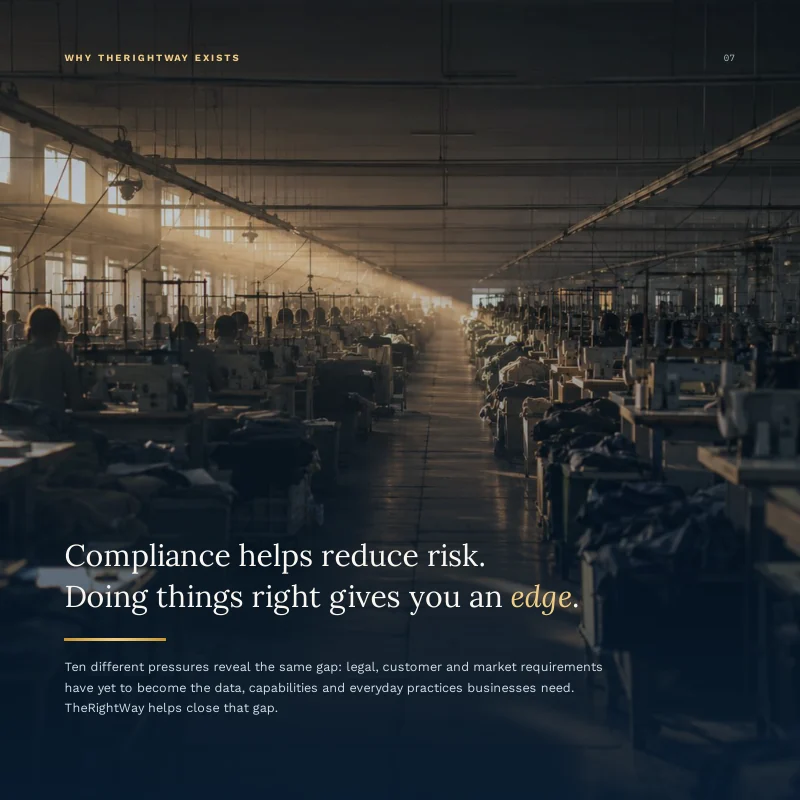
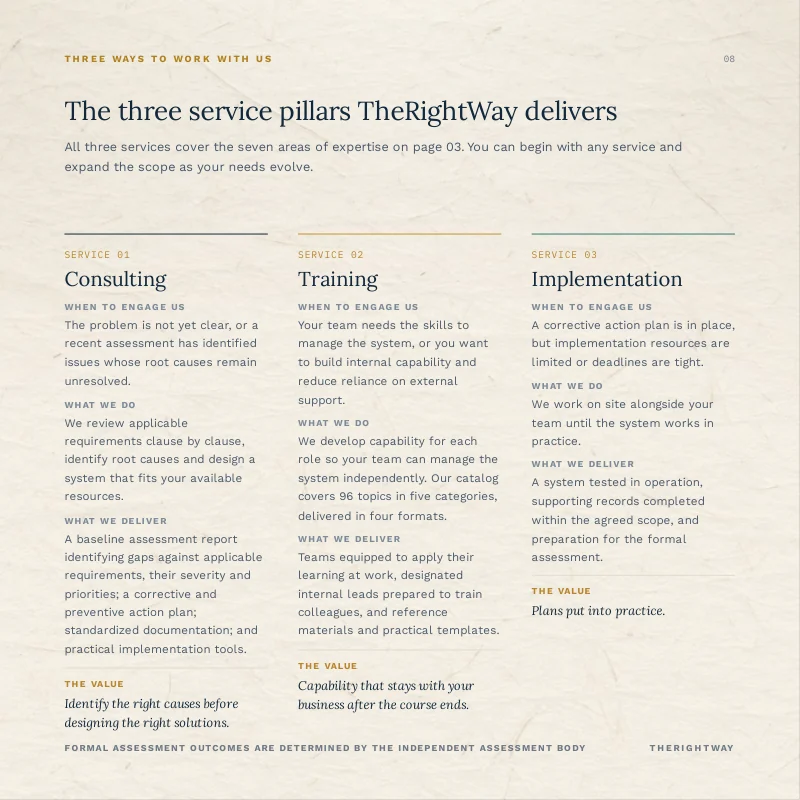
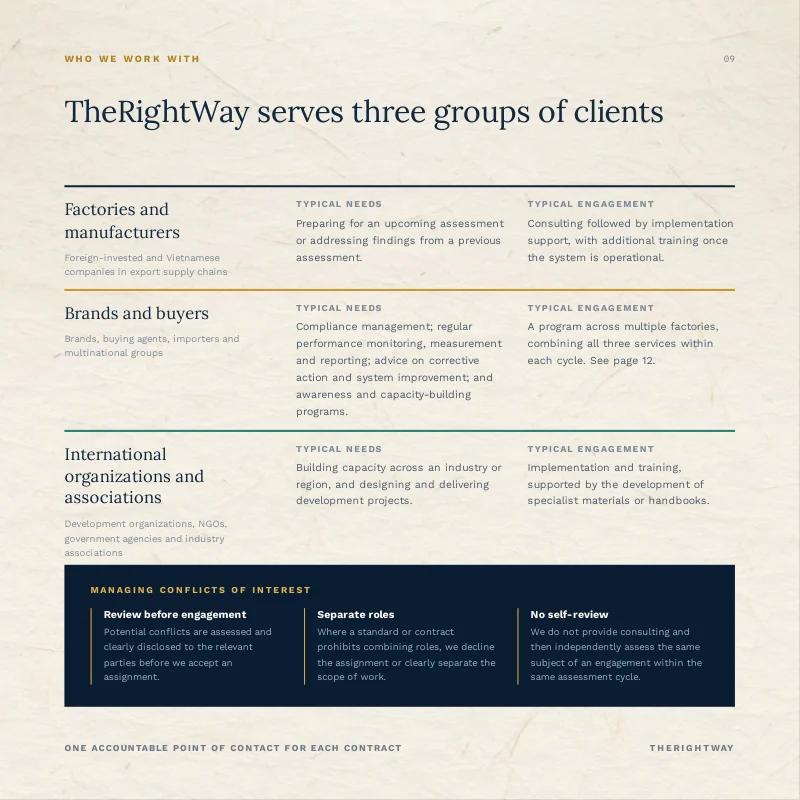
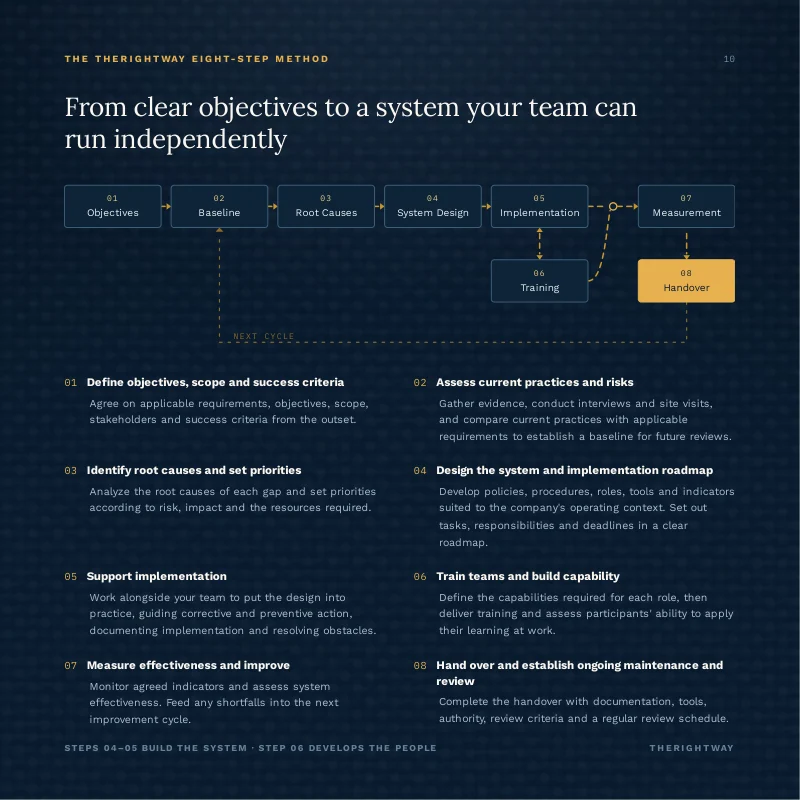
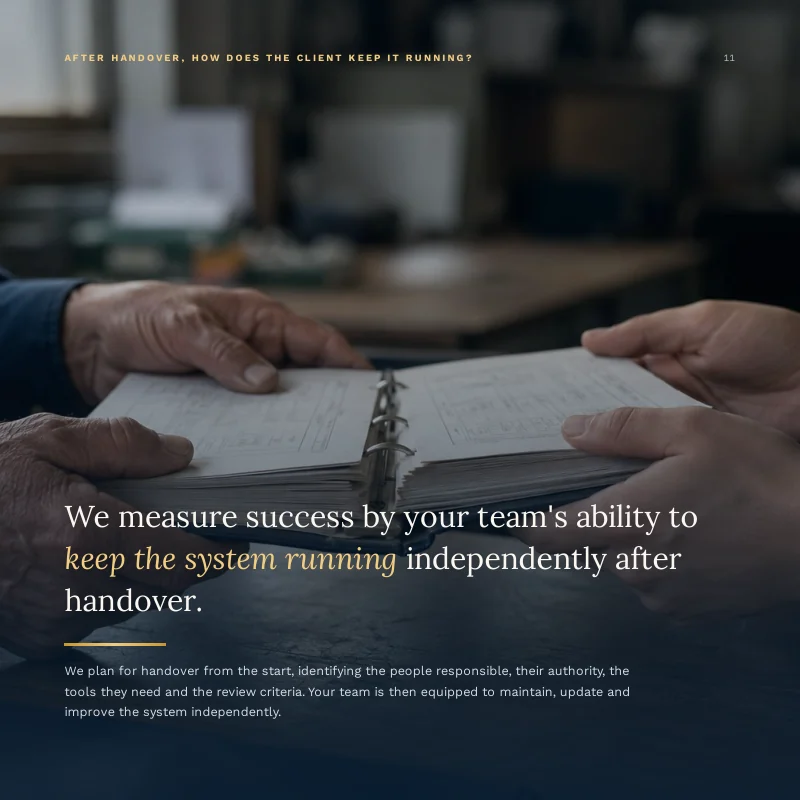
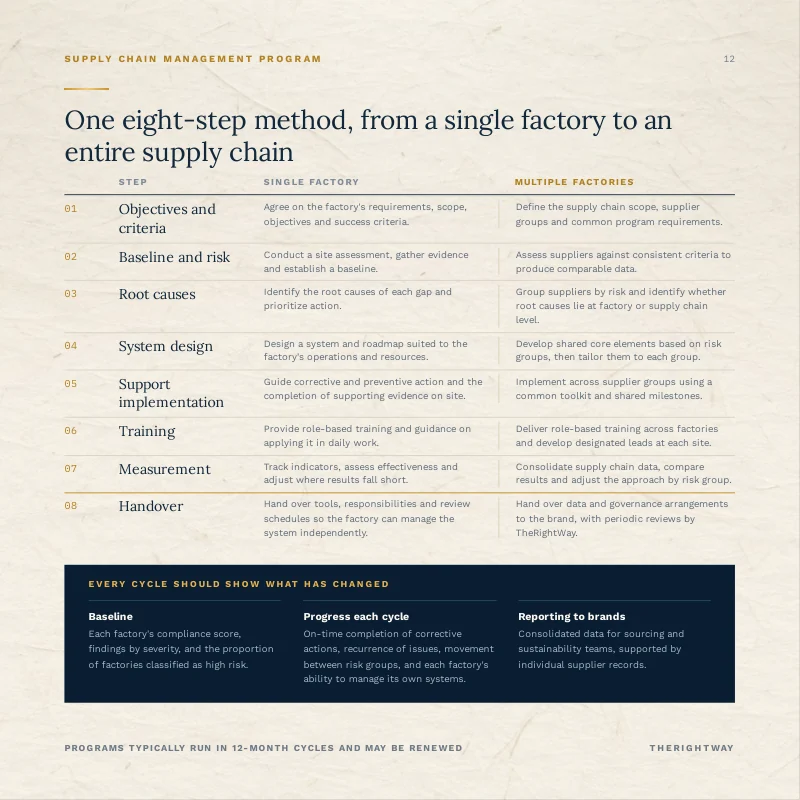
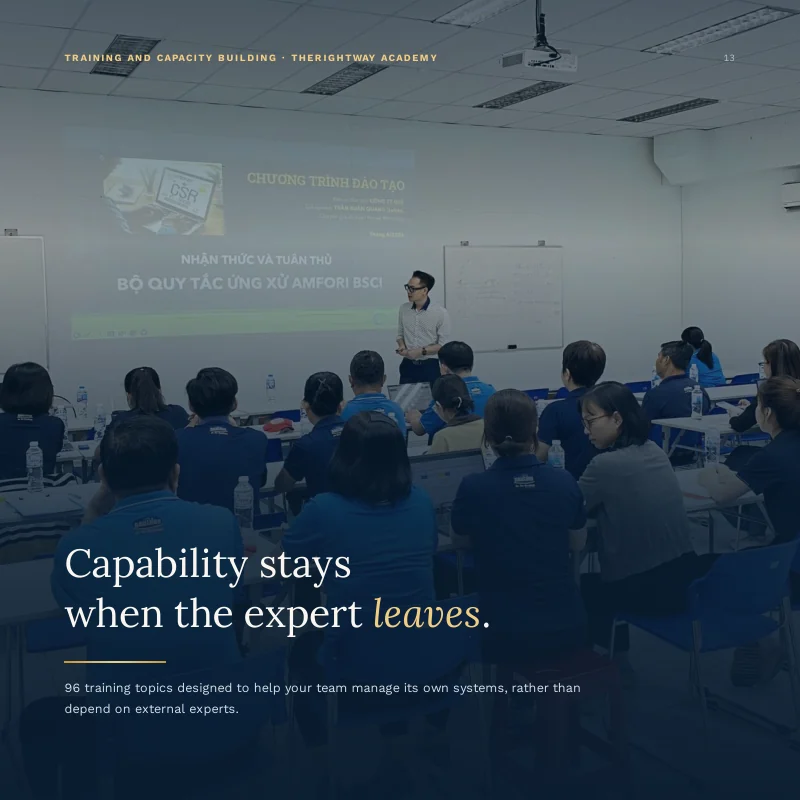
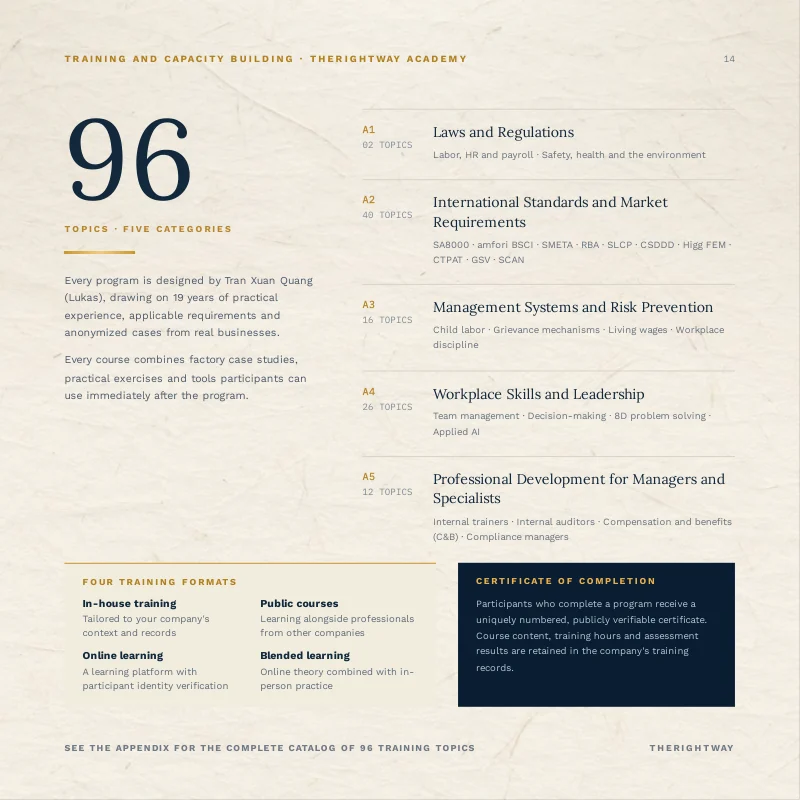
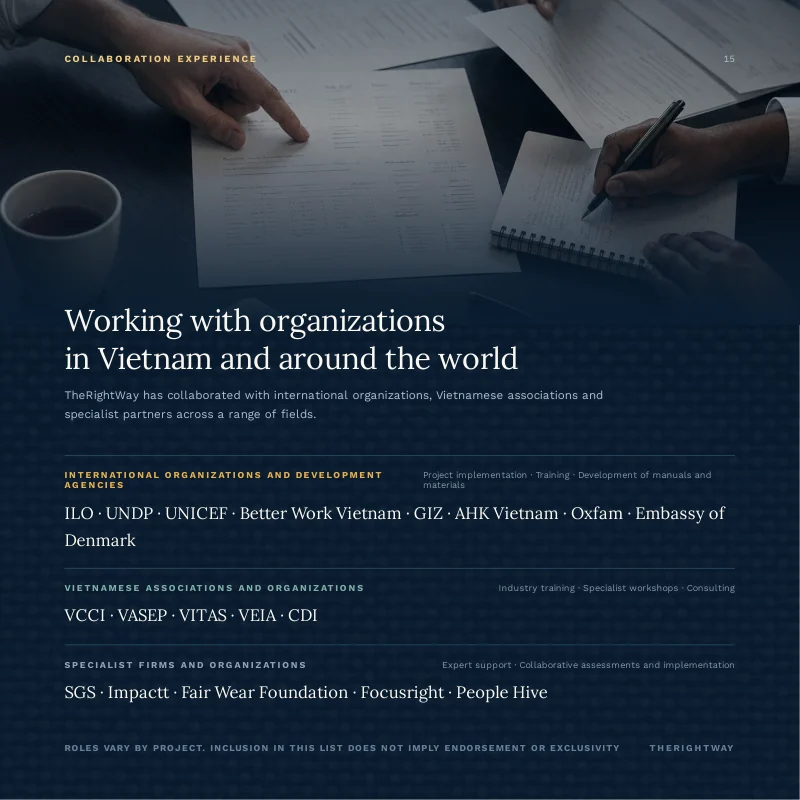
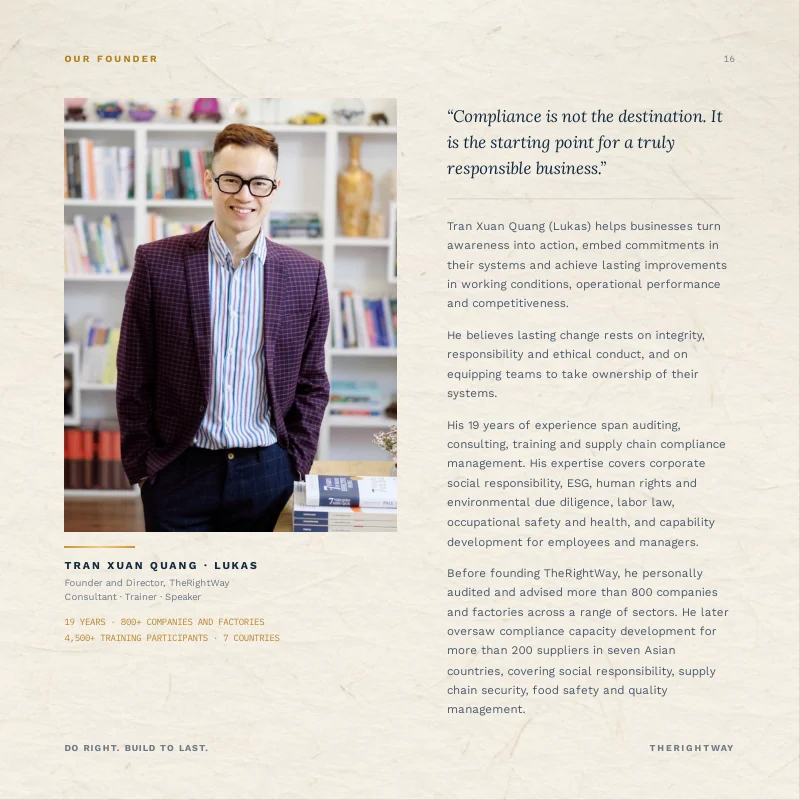
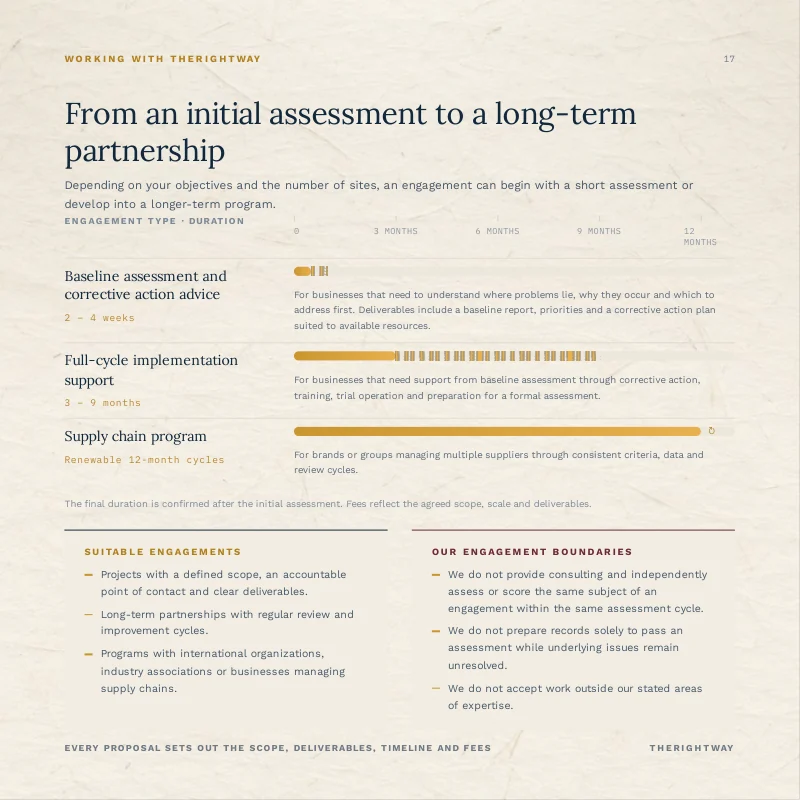
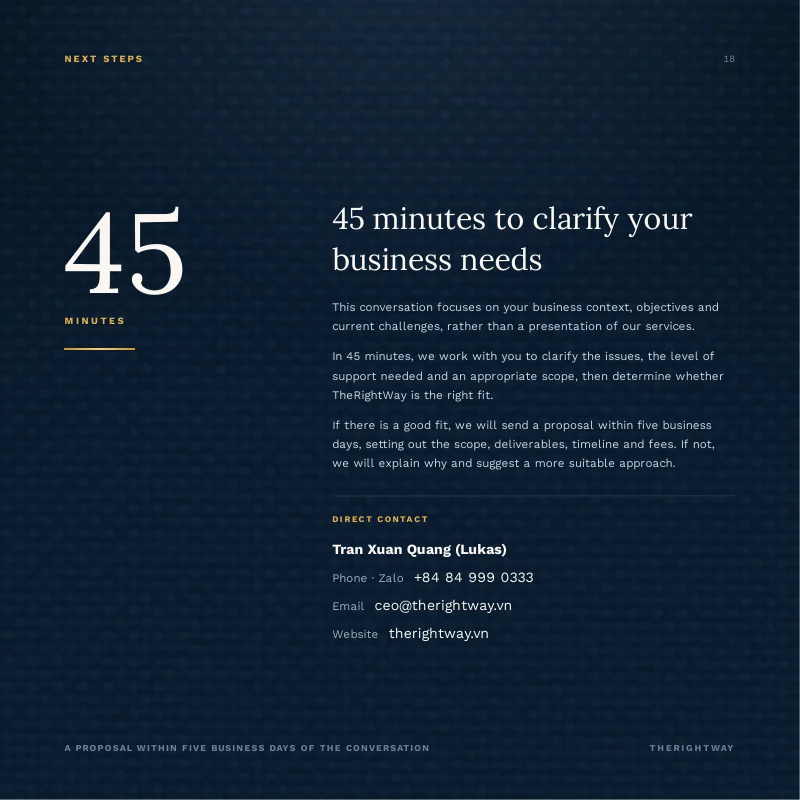
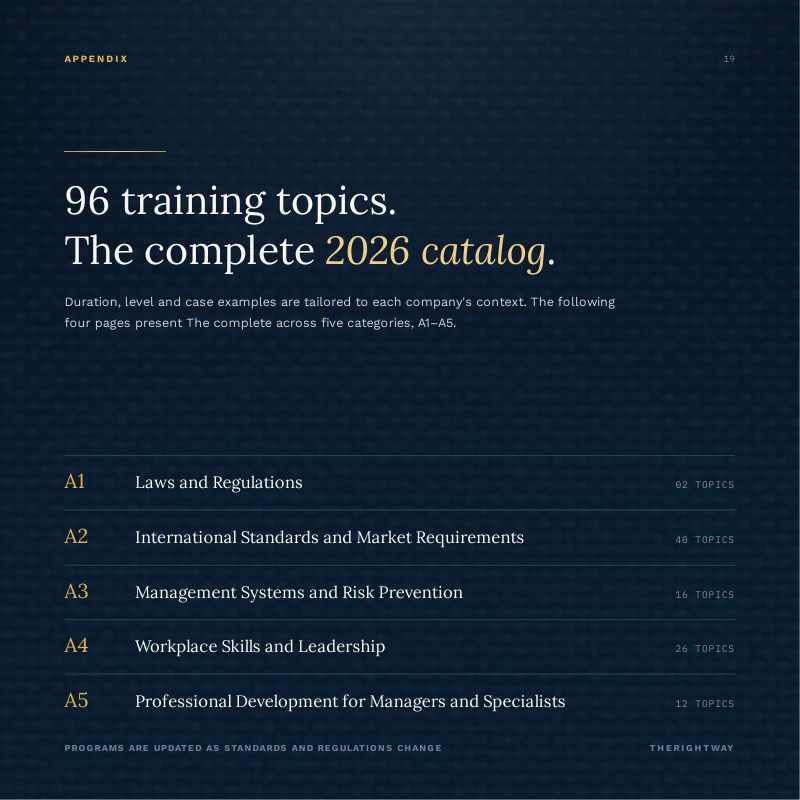
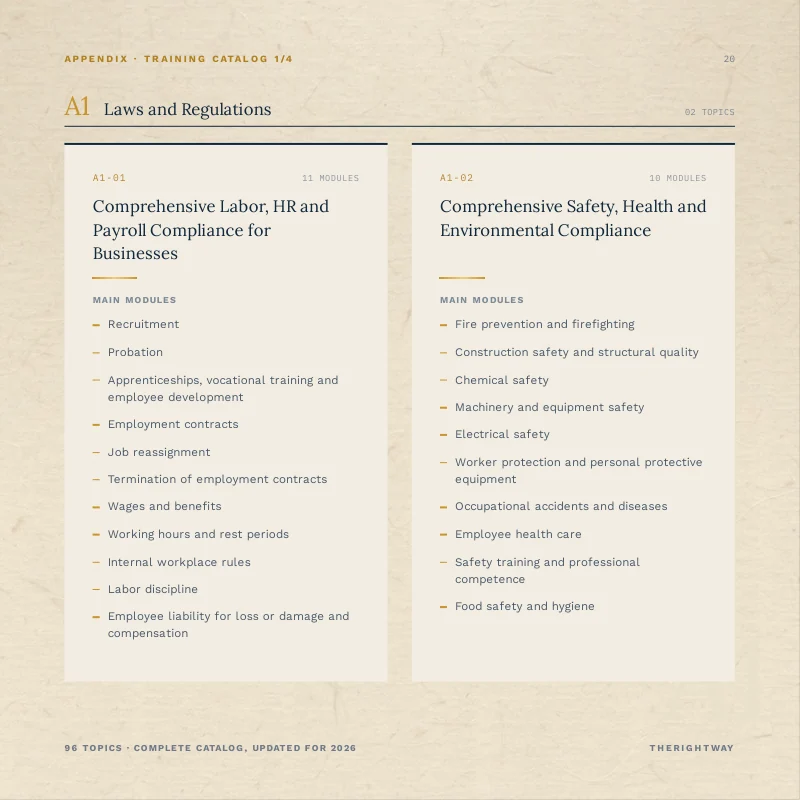
COMPANY PROFILE Do Right. Build to Last. HANOI · 2026A well-made product starts with precise stitching. A lasting business starts with doing things right. 02OUR EXPERTISE 03 TheRightWay's seven areas of expertise AREA OF EXPERTISE · MANAGEMENT OBJECTIVE SELECTED STANDARDS, FRAMEWORKS, PROGRAMS AND REQUIREMENTS 01 Labor and Social Responsibility Working conditions that meet customer requirements and international standards amfori BSCI · SMETA · SA8000 · RBA · WRAP · ESCP · WCA · SLCP · PSCI · Better Work · Fair Wear Foundation · FLA · LABS 02 Environment and Sustainable Products Support for material certification and the management of environmental impacts at facility level 4C · bluesign · ESPR · Fairtrade · FSA (SAI Platform) · FSC CoC · GOTS · GRS · Higg FEM · LWG · OEKO-TEX · PEFC · ZDHC 03 ESG and Sustainability Reporting Reporting that stands up to scrutiny from investors and lenders CDP · CSRD / ESRS · GHG Protocol · GRI Standards · IFC Performance Standards · IFRS S1 and IFRS S2 (ISSB) · TCFD recommendations 04 Human Rights and Environmental Due Diligence Responding to buyers' data and traceability requirements EU CSDDD · LkSG (Germany) · HREDD · OECD Due Diligence Guidance · UFLPA (United States) · UN Guiding Principles on Business and Human Rights 05 Supply Chain Security and Customs Compliance Keeping goods moving into export markets CTPAT · GSV · SCAN · TAPA · Supply chain security 06 Animal Welfare Meeting animal welfare requirements across the food supply chain Five Freedoms · WOAH standards (formerly OIE) 07 Management Systems and Risk Prevention HR, payroll, safety and internal processes that your team can manage independently Occupational safety and health · Payroll and timekeeping · Living wages · KPIs and OKRs · Responsible recruitment · Grievance mechanisms · Workplace discipline · Internal communications · Prevention of harassment and violence · Diversity, equity and inclusion (DEI) · Forced labor · Discrimination · Child labor SELECTED EXAMPLES. APPLICABLE VERSIONS AND SCOPE ARE CONFIRMED FOR EACH PROJECT. THERIGHTWAYTHERIGHTWAY IN SIX NUMBERS 04 Experience in numbers, through 2026 100+ standards and codes of conduct covered through consulting and training 19 years of practical experience held by our founder 800+ companies and factories supported through consulting, assessments or training 18 manufacturing and service sectors served 4,500+ participants in training programs 96 training topics developed TheRightWay provides consulting, training and implementation support to help businesses and supply chains turn compliance requirements into operational capability, competitive advantage and a foundation for sustainable development. CUMULATIVE FIGURES THROUGH 2026 THERIGHTWAYWHAT WE STAND FOR 05 Compliance creates value when it becomes part of how a business operates every day. OUR PURPOSE TheRightWay was founded to demonstrate that doing the right thing is both a responsibility and the foundation of lasting success. PROMISE Turning compliance pressure into business capability. MISSION We provide consulting, training and implementation support that help businesses and supply chains translate compliance and responsible business requirements into operational capability, competitiveness and sustainable development. OUR CORE VALUES 01Do Right Choose what is right over shortcuts, even when the right path is harder. 02Make It Work Turn solutions into systems, processes and everyday practices that work beyond the page. 03Create Real Impact Measure success by meaningful changes in capability, behavior and results, rather than appearances, scores or certificates on the wall. 04Build Trust Be transparent, consistent and reliable in every recommendation, commitment and deliverable. 05Grow Together Work alongside clients, colleagues and communities to build capability and develop sustainably together. DO RIGHT. BUILD TO LAST. THERIGHTWAYTEN PRESSURES 06 Ten pressures reshaping how manufacturers operate MARKET AND SUPPLY CHAIN PRESSURES · 01–05 01 Brands need data. Companies lack the systems. Reporting requests are becoming more frequent, sometimes monthly, while data remains scattered across emails, spreadsheets and the knowledge of a few individuals. 02 Requirements now extend beyond customers. Alongside brand codes of conduct, companies are asked to provide data that supports applicable legal obligations relating to human rights, environmental and supply chain due diligence. 03 Traceability must extend from sourcing to production conditions Quality and price are no longer enough. Markets also require traceability, environmental impact data and evidence of respect for human rights. 04 Requirements multiply without a common management framework. Local laws, multiple customer codes and international standards apply simultaneously. Without an integrated framework, work is duplicated and systems remain fragmented. 05 Responsibility extends beyond direct suppliers. Companies need to identify materials, subcontractors and risks beyond their direct suppliers. A single issue can affect the entire supply chain. INTERNAL OPERATIONAL PRESSURES · 06–10 06 Corrective actions repeat. Problems return. When findings are addressed without resolving their root causes, the same issues often recur at the next assessment, sometimes in a different form. 07 Systems exist on paper but depend on a few people. Records may be complete, yet knowledge and day-to-day operations rest with one or two individuals. When they become overstretched or leave, the system is disrupted. 08 Requirements are rising faster than team capability. Teams must understand laws, standards and customer requirements, then translate them into consistent processes, data and action. 09 Time and cost pressures undermine commitments. Urgent orders or sudden increases in production can lead to established procedures being bypassed unless business objectives and compliance are managed together. 10 Compliance responsibilities are spread across departments. HR, production, purchasing, health, safety and environment (HSE), and sustainability teams each hold part of the data. Without effective coordination, the same requirement can be interpreted in different ways. LEGAL AND MARKET CONTEXT AS OF AUGUST 27, 2026 THERIGHTWAYWHY THERIGHTWAY EXISTS 07 Compliance helps reduce risk. Doing things right gives you an edge. Ten different pressures reveal the same gap: legal, customer and market requirements have yet to become the data, capabilities and everyday practices businesses need. TheRightWay helps close that gap.THREE WAYS TO WORK WITH US 08 The three service pillars TheRightWay delivers All three services cover the seven areas of expertise on page 03. You can begin with any service and expand the scope as your needs evolve. SERVICE 01 Consulting WHEN TO ENGAGE US The problem is not yet clear, or a recent assessment has identified issues whose root causes remain unresolved. WHAT WE DO We review applicable requirements clause by clause, identify root causes and design a system that fits your available resources. WHAT WE DELIVER A baseline assessment report identifying gaps against applicable requirements, their severity and priorities; a corrective and preventive action plan; standardized documentation; and practical implementation tools. THE VALUE Identify the right causes before designing the right solutions. SERVICE 02 Training WHEN TO ENGAGE US Your team needs the skills to manage the system, or you want to build internal capability and reduce reliance on external support. WHAT WE DO We develop capability for each role so your team can manage the system independently. Our catalog covers 96 topics in five categories, delivered in four formats. WHAT WE DELIVER Teams equipped to apply their learning at work, designated internal leads prepared to train colleagues, and reference materials and practical templates. THE VALUE Capability that stays with your business after the course ends. SERVICE 03 Implementation WHEN TO ENGAGE US A corrective action plan is in place, but implementation resources are limited or deadlines are tight. WHAT WE DO We work on site alongside your team until the system works in practice. WHAT WE DELIVER A system tested in operation, supporting records completed within the agreed scope, and preparation for the formal assessment. THE VALUE Plans put into practice. FORMAL ASSESSMENT OUTCOMES ARE DETERMINED BY THE INDEPENDENT ASSESSMENT BODY THERIGHTWAYWHO WE WORK WITH 09 TheRightWay serves three groups of clients Factories and manufacturers Foreign-invested and Vietnamese companies in export supply chains TYPICAL NEEDS Preparing for an upcoming assessment or addressing findings from a previous assessment. TYPICAL ENGAGEMENT Consulting followed by implementation support, with additional training once the system is operational. Brands and buyers Brands, buying agents, importers and multinational groups TYPICAL NEEDS Compliance management; regular performance monitoring, measurement and reporting; advice on corrective action and system improvement; and awareness and capacity-building programs. TYPICAL ENGAGEMENT A program across multiple factories, combining all three services within each cycle. See page 12. International organizations and associations Development organizations, NGOs, government agencies and industry associations TYPICAL NEEDS Building capacity across an industry or region, and designing and delivering development projects. TYPICAL ENGAGEMENT Implementation and training, supported by the development of specialist materials or handbooks. MANAGING CONFLICTS OF INTEREST Review before engagement Potential conflicts are assessed and clearly disclosed to the relevant parties before we accept an assignment. Separate roles Where a standard or contract prohibits combining roles, we decline the assignment or clearly separate the scope of work. No self-review We do not provide consulting and then independently assess the same subject of an engagement within the same assessment cycle. ONE ACCOUNTABLE POINT OF CONTACT FOR EACH CONTRACT THERIGHTWAYTHE THERIGHTWAY EIGHT-STEP METHOD 10 From clear objectives to a system your team can run independently 01 Objectives 02 Baseline 03 Root Causes 04 System Design 05 Implementation 06 Training 07 Measurement 08 Handover NEXT CYCLE 01 Define objectives, scope and success criteria Agree on applicable requirements, objectives, scope, stakeholders and success criteria from the outset. 02 Assess current practices and risks Gather evidence, conduct interviews and site visits, and compare current practices with applicable requirements to establish a baseline for future reviews. 03 Identify root causes and set priorities Analyze the root causes of each gap and set priorities according to risk, impact and the resources required. 04 Design the system and implementation roadmap Develop policies, procedures, roles, tools and indicators suited to the company's operating context. Set out tasks, responsibilities and deadlines in a clear roadmap. 05 Support implementation Work alongside your team to put the design into practice, guiding corrective and preventive action, documenting implementation and resolving obstacles. 06 Train teams and build capability Define the capabilities required for each role, then deliver training and assess participants' ability to apply their learning at work. 07 Measure effectiveness and improve Monitor agreed indicators and assess system effectiveness. Feed any shortfalls into the next improvement cycle. 08 Hand over and establish ongoing maintenance and review Complete the handover with documentation, tools, authority, review criteria and a regular review schedule. STEPS 04–05 BUILD THE SYSTEM · STEP 06 DEVELOPS THE PEOPLE THERIGHTWAYAFTER HANDOVER, HOW DOES THE CLIENT KEEP IT RUNNING? 11 We measure success by your team's ability to keep the system running independently after handover. We plan for handover from the start, identifying the people responsible, their authority, the tools they need and the review criteria. Your team is then equipped to maintain, update and improve the system independently.SUPPLY CHAIN MANAGEMENT PROGRAM 12 One eight-step method, from a single factory to an entire supply chain STEP SINGLE FACTORY MULTIPLE FACTORIES 01 Objectives and criteria Agree on the factory's requirements, scope, objectives and success criteria. Define the supply chain scope, supplier groups and common program requirements. 02 Baseline and risk Conduct a site assessment, gather evidence and establish a baseline. Assess suppliers against consistent criteria to produce comparable data. 03 Root causes Identify the root causes of each gap and prioritize action. Group suppliers by risk and identify whether root causes lie at factory or supply chain level. 04 System design Design a system and roadmap suited to the factory's operations and resources. Develop shared core elements based on risk groups, then tailor them to each group. 05 Support implementation Guide corrective and preventive action and the completion of supporting evidence on site. Implement across supplier groups using a common toolkit and shared milestones. 06 Training Provide role-based training and guidance on applying it in daily work. Deliver role-based training across factories and develop designated leads at each site. 07 Measurement Track indicators, assess effectiveness and adjust where results fall short. Consolidate supply chain data, compare results and adjust the approach by risk group. 08 Handover Hand over tools, responsibilities and review schedules so the factory can manage the system independently. Hand over data and governance arrangements to the brand, with periodic reviews by TheRightWay. EVERY CYCLE SHOULD SHOW WHAT HAS CHANGED Baseline Each factory's compliance score, findings by severity, and the proportion of factories classified as high risk. Progress each cycle On-time completion of corrective actions, recurrence of issues, movement between risk groups, and each factory's ability to manage its own systems. Reporting to brands Consolidated data for sourcing and sustainability teams, supported by individual supplier records. PROGRAMS TYPICALLY RUN IN 12-MONTH CYCLES AND MAY BE RENEWED THERIGHTWAYTRAINING AND CAPACITY BUILDING · THERIGHTWAY ACADEMY 13 Capability stays when the expert leaves. 96 training topics designed to help your team manage its own systems, rather than depend on external experts.TRAINING AND CAPACITY BUILDING · THERIGHTWAY ACADEMY 14 96 TOPICS · FIVE CATEGORIES Every program is designed by Tran Xuan Quang (Lukas), drawing on 19 years of practical experience, applicable requirements and anonymized cases from real businesses. Every course combines factory case studies, practical exercises and tools participants can use immediately after the program. A1 02 TOPICS Laws and Regulations Labor, HR and payroll · Safety, health and the environment A2 40 TOPICS International Standards and Market Requirements SA8000 · amfori BSCI · SMETA · RBA · SLCP · CSDDD · Higg FEM · CTPAT · GSV · SCAN A3 16 TOPICS Management Systems and Risk Prevention Child labor · Grievance mechanisms · Living wages · Workplace discipline A4 26 TOPICS Workplace Skills and Leadership Team management · Decision-making · 8D problem solving · Applied AI A5 12 TOPICS Professional Development for Managers and Specialists Internal trainers · Internal auditors · Compensation and benefits (C&B) · Compliance managers FOUR TRAINING FORMATS In-house training Tailored to your company's context and records Public courses Learning alongside professionals from other companies Online learning A learning platform with participant identity verification Blended learning Online theory combined with in- person practice CERTIFICATE OF COMPLETION Participants who complete a program receive a uniquely numbered, publicly verifiable certificate. Course content, training hours and assessment results are retained in the company's training records. SEE THE APPENDIX FOR THE COMPLETE CATALOG OF 96 TRAINING TOPICS THERIGHTWAYCOLLABORATION EXPERIENCE 15 Working with organizations in Vietnam and around the world TheRightWay has collaborated with international organizations, Vietnamese associations and specialist partners across a range of fields. INTERNATIONAL ORGANIZATIONS AND DEVELOPMENT AGENCIES Project implementation · Training · Development of manuals and materials ILO · UNDP · UNICEF · Better Work Vietnam · GIZ · AHK Vietnam · Oxfam · Embassy of Denmark VIETNAMESE ASSOCIATIONS AND ORGANIZATIONS Industry training · Specialist workshops · Consulting VCCI · VASEP · VITAS · VEIA · CDI SPECIALIST FIRMS AND ORGANIZATIONS Expert support · Collaborative assessments and implementation SGS · Impactt · Fair Wear Foundation · Focusright · People Hive ROLES VARY BY PROJECT. INCLUSION IN THIS LIST DOES NOT IMPLY ENDORSEMENT OR EXCLUSIVITY THERIGHTWAYOUR FOUNDER 16 TRAN XUAN QUANG · LUKAS Founder and Director, TheRightWay Consultant · Trainer · Speaker 19 YEARS · 800+ COMPANIES AND FACTORIES 4,500+ TRAINING PARTICIPANTS · 7 COUNTRIES “Compliance is not the destination. It is the starting point for a truly responsible business.” Tran Xuan Quang (Lukas) helps businesses turn awareness into action, embed commitments in their systems and achieve lasting improvements in working conditions, operational performance and competitiveness. He believes lasting change rests on integrity, responsibility and ethical conduct, and on equipping teams to take ownership of their systems. His 19 years of experience span auditing, consulting, training and supply chain compliance management. His expertise covers corporate social responsibility, ESG, human rights and environmental due diligence, labor law, occupational safety and health, and capability development for employees and managers. Before founding TheRightWay, he personally audited and advised more than 800 companies and factories across a range of sectors. He later oversaw compliance capacity development for more than 200 suppliers in seven Asian countries, covering social responsibility, supply chain security, food safety and quality management. DO RIGHT. BUILD TO LAST. THERIGHTWAYWORKING WITH THERIGHTWAY 17 From an initial assessment to a long-term partnership Depending on your objectives and the number of sites, an engagement can begin with a short assessment or develop into a longer-term program. ENGAGEMENT TYPE · DURATION Baseline assessment and corrective action advice 2 – 4 weeks For businesses that need to understand where problems lie, why they occur and which to address first. Deliverables include a baseline report, priorities and a corrective action plan suited to available resources. Full-cycle implementation support 3 – 9 months For businesses that need support from baseline assessment through corrective action, training, trial operation and preparation for a formal assessment. Supply chain program Renewable 12-month cycles For brands or groups managing multiple suppliers through consistent criteria, data and review cycles. The final duration is confirmed after the initial assessment. Fees reflect the agreed scope, scale and deliverables. SUITABLE ENGAGEMENTS OUR ENGAGEMENT BOUNDARIES 0 3 MONTHS 6 MONTHS 9 MONTHS 12 MONTHS ↻ Projects with a defined scope, an accountable point of contact and clear deliverables. Long-term partnerships with regular review and improvement cycles. Programs with international organizations, industry associations or businesses managing supply chains. We do not provide consulting and independently assess or score the same subject of an engagement within the same assessment cycle. We do not prepare records solely to pass an assessment while underlying issues remain unresolved. We do not accept work outside our stated areas of expertise. EVERY PROPOSAL SETS OUT THE SCOPE, DELIVERABLES, TIMELINE AND FEES THERIGHTWAYNEXT STEPS 18 45 MINUTES 45 minutes to clarify your business needs This conversation focuses on your business context, objectives and current challenges, rather than a presentation of our services. In 45 minutes, we work with you to clarify the issues, the level of support needed and an appropriate scope, then determine whether TheRightWay is the right fit. If there is a good fit, we will send a proposal within five business days, setting out the scope, deliverables, timeline and fees. If not, we will explain why and suggest a more suitable approach. DIRECT CONTACT Tran Xuan Quang (Lukas) Phone · Zalo +84 84 999 0333 Email ceo@therightway.vn Website therightway.vn A PROPOSAL WITHIN FIVE BUSINESS DAYS OF THE CONVERSATION THERIGHTWAYAPPENDIX 19 96 training topics. The complete 2026 catalog. Duration, level and case examples are tailored to each company's context. The following four pages present The complete across five categories, A1–A5. A1 Laws and Regulations 02 TOPICS A2 International Standards and Market Requirements 40 TOPICS A3 Management Systems and Risk Prevention 16 TOPICS A4 Workplace Skills and Leadership 26 TOPICS A5 Professional Development for Managers and Specialists 12 TOPICS PROGRAMS ARE UPDATED AS STANDARDS AND REGULATIONS CHANGE THERIGHTWAYAPPENDIX · TRAINING CATALOG 1/4 20 A1 A1 Laws and Regulations 02 TOPICS A1-01 11 MODULES Comprehensive Labor, HR and Payroll Compliance for Businesses MAIN MODULES A1-02 10 MODULES Comprehensive Safety, Health and Environmental Compliance MAIN MODULES Recruitment Probation Apprenticeships, vocational training and employee development Employment contracts Job reassignment Termination of employment contracts Wages and benefits Working hours and rest periods Internal workplace rules Labor discipline Employee liability for loss or damage and compensation Fire prevention and firefighting Construction safety and structural quality Chemical safety Machinery and equipment safety Electrical safety Worker protection and personal protective equipment Occupational accidents and diseases Employee health care Safety training and professional competence Food safety and hygiene 96 TOPICS · COMPLETE CATALOG, UPDATED FOR 2026 THERIGHTWAYAPPENDIX · TRAINING CATALOG 2/4 21 A2 A2 International Standards and Market Requirements 40 TOPICS Each topic is structured around either understanding and compliance or in-depth application and implementation of the relevant standard, program or regulation. 01 SA8000 Standard 02 amfori BSCI Code of Conduct 03 SMETA Audit Methodology (Sedex) 04 RBA Code of Conduct and Validated Assessment Program (VAP) 05 WRAP Program 06 ESCP Program 07 FLA Workplace Code of Conduct 08 Social & Labor Convergence Program (SLCP) 09 Workplace Conditions Assessment (WCA, Intertek) 10 Life and Building Safety (LABS) Initiative 11 Better Work 12 Fair Wear Code of Labour Practices 13 Higg Facility Environmental Module (Higg FEM) 14 Higg Facility Social & Labor Module (Higg FSLM) 15 Global Recycled Standard (GRS) 16 Global Organic Textile Standard (GOTS) 17 OEKO-TEX Standards and Certification Programs 18 ZDHC Program 19 bluesign System 20 Cradle to Cradle Certified Product Standard 21 EU Ecodesign for Sustainable Products Regulation (ESPR): Preparing for Product Requirements and Market Access 22 Leather Working Group (LWG) Standards 23 FSC Chain of Custody Standard 24 PEFC Forest Certification 25 Fairtrade Standards 26 Corporate ESG Reporting Framework 27 GRI Standards 28 IFRS Sustainability Disclosure Standards: IFRS S1 and IFRS S2 29 Corporate Sustainability Reporting Directive (CSRD) and European Sustainability Reporting Standards (ESRS) 30 Human Rights and Environmental Due Diligence (HREDD): CSDDD and LkSG Requirements 31 GHG Protocol: Scope 1, 2 and 3 Emissions Accounting and Reporting 32 IFC Performance Standards on Environmental and Social Sustainability 33 Pharmaceutical Supply Chain Initiative (PSCI) 34 4C Code of Conduct: Sustainable Coffee from Farm to Export 35 Farm Sustainability Assessment (FSA, SAI Platform) 36 Applying the Five Freedoms in Animal Welfare Management 37 WOAH Standards: Animal Health and Welfare (formerly OIE) 38 CTPAT Supply Chain Security Program 39 Global Security Verification (GSV) Program 40 Supplier Compliance Audit Network (SCAN) 96 TOPICS · COMPLETE CATALOG, UPDATED FOR 2026 THERIGHTWAYAPPENDIX · TRAINING CATALOG 3/4 22 A3 A3 Management Systems and Risk Prevention 16 TOPICS This category covers HR, payroll, safety and internal processes that companies need to manage independently after handover. 01 Building Workplace Systems to Prevent and Remediate Child Labor 02 Identifying and Preventing Forced Labor in the Workplace 03 Preventing Workplace Discrimination 04 Building a Workplace Culture of Diversity, Equity and Inclusion (DEI) 05 Establishing Transparent, Effective and Ongoing Workplace Dialogue 06 Building Confidential, Trusted Workplace Grievance and Whistleblowing Mechanisms 07 Preventing Sexual Harassment and Violence in the Workplace 08 Understanding Living Wages: Calculation and Implementation 09 Strengthening Labor Relations and Trade Union Capacity in the Workplace 10 Standardizing Payroll and Timekeeping Systems 11 Designing Total Rewards Systems and the 3P+ Pay Model 12 Managing Workplace Discipline Effectively and Lawfully 13 Managing Rumors and Internal Communications During a Crisis 14 Building Responsible, High-Performing Recruitment Systems 15 Developing KPIs, OKRs and Data-Driven HR Performance Measures 16 Designing Modern, Efficient Pay Structures, Policies and Payroll Systems MANAGEMENT OBJECTIVE HR, payroll, safety and internal processes that the company can manage independently, corresponding to area 07 on page 03. Businesses typically turn to these topics after an assessment, when they want to take ownership of their systems and reduce dependence on external experts. 96 TOPICS · COMPLETE CATALOG, UPDATED FOR 2026 THERIGHTWAYAPPENDIX · TRAINING CATALOG 4/4 23 A5 A4 Workplace Skills and Leadership 26 TOPICS 01 Effective Team Management and Leadership 02 Effective Decision-Making Under Pressure and Uncertainty 03 The Art of Assigning Work and Delegating Authority 04 Motivating Teams and Building Team Cohesion 05 Coaching, Mentoring and Developing Talent 06 Resolving Workplace Conflict 07 Understanding and Applying AI for Business Leaders 08 Leading and Managing a Multigenerational Workforce: Gen Z, Millennials and Gen X 09 Effective Leadership in a Hybrid Workplace 10 Effective Communication, Listening and Clear Messaging 11 Presentation Skills and Public Speaking 12 Giving Feedback and Guiding Employee Behavior 13 Building Positive Discipline and Team Culture 14 Root Cause Analysis and 8D Problem Solving 15 Effective Planning and Work Management 16 Setting Goals and Prioritizing Work 17 Systems Thinking and Complex Problem Solving 18 Microlearning and Gamification in Training Design 19 Developing Emotional Intelligence (EQ) for Leaders 20 Managing Stress and Balancing Work and Life 21 Self-Directed Learning and Continuous Development 22 Self-Leadership and Personal Capability Development 23 Managing Mental Health and Psychological Well-Being at Work 24 Applied AI for Greater Workplace Productivity 25 Creative and Innovative Thinking Through Brainstorming and Mind Mapping 26 Identifying and Assessing Labor, Occupational Safety, Environmental and Ethical Risks A5 Professional Development for Managers and Specialists 12 TOPICS 01 Professional Internal Trainer: Train-the-Trainer 02 Internal Social Compliance Auditor 03 Recruitment and Talent Acquisition Specialist 04 Compensation and Benefits Specialist (C&B) 05 Employee Relations Specialist 06 Occupational Safety and Environmental Specialist 07 Labor and HR Compliance Manager 08 Occupational Safety and Environmental Compliance Manager 09 Supply Chain Compliance Manager 10 Chief Compliance Officer: Strategic Corporate and Supply Chain Compliance Management 11 International HR Management for a New Era 12 Professional Social Compliance Auditor (PSCA) 96 TOPICS · COMPLETE CATALOG, UPDATED FOR 2026 THERIGHTWAYSIX PRINCIPLES WE WILL NOT COMPROMISE ON 01 We do not advise clients to violate laws, standards or customer requirements. 02 We do not make misleading records appear legitimate, fabricate evidence or conceal actual conditions. 03 We do not take shortcuts in place of addressing root causes. 04 We do not build compliance systems that exist only on paper or for appearances. 05 We do not stop at reports, recommendations or documentation. TheRightWay helps clients put solutions into practice and achieve meaningful change. 06 We do not build systems that leave clients dependent on TheRightWay. These principles protect the integrity of every project and the lasting value it creates for clients. We are prepared to say no to the wrong approach and work with clients to build businesses that do right and last. Responsible Business. Sustainable Success. TheRightWay Responsible Business and Sustainability Co., Ltd. 46 Truong Lam Street, Viet Hung Ward, Hanoi, Vietnam ceo@therightway.vn · +84 84 999 0333 · therightway.vn 21.0000° N · 105.8500° E 2026